Let me start by acknowledging the awkwardness of discussing the films of 2008 at the close of April 2009. I realize that many of these movies are long forgotten, the Golden Globes and Oscars having beaten any remaining interest into the ground.
I for one, however, still have not seen all of the films released in 2008 that I had originally intended to. What's more, I have little doubt that the vast majority of individuals that voted on the aforementioned awards would say the same. Nonetheless, I have finally reached the point where I have seen enough to merit this post. So that's that.
Now, I've heard every argument in the book against making "stupid, pointless lists" at the end of the year, but fuck it, I like them. So here's mine. These are the films I saw from last year and the grade I would give them. Yes, grades are somewhat arbitrary. Deal with it.
The List
The Wrestler -- A+
In Bruges -- A
WALL-E -- A
Frost/Nixon -- B+
The Reader -- B+
Waltz With Bashir -- B+
Marley & Me -- B
The Dark Knight -- B
Man on Wire -- B
Vicky Christina Barcelona -- B-
Slumdog Millionaire -- B-
Changeling -- C+
The Fall -- C+
The Curious Case of Benjamin Button -- C
Iron Man -- C
Ché, Pt. I -- C-
Quantum of Solace -- D+
Defiance -- D+
Bolt -- D
Films I Have Not Seen, But Would Like To:
Revolutionary Road [see Dave's review here]
Gran Torino
Doubt
Happy-Go-Lucky
Burn After Reading
Australia
Tropic Thunder
Pineapple Express
More on Five:
1. The Wrestler (director: Darren Aronofsky; starring: Mickey Rourke, Marisa Tomei, Evan Rachel Wood)

The best film I saw in 2008, hands down, and probably the best movie I've seen in recent memory. Much of this is due to Mickey Rourke's realistic portrayal of Randy "The Ram" Robinson, a washed-up semi-pro wrestler, living in a trailer park and searching desperately to reclaim some purpose in his life. Credit must also be given to director Darren Aronofsky (Requiem for a Dream, Pi) who finally made a movie I didn't just "appreciate," but enjoyed. In particular, there's an insanely brilliant scene where Aronofsky's camera follows Rourke from an upstairs bathroom in the grocery store where he works, down the stairs, across the stockroom, through a pathetic plastic curtain, and into the deli. It's all done to the faintly heard rumbles of a crowd cheering, apparently heard in his head, and this short description doesn't do it anywhere near the justice it deserves.
The movie's real triumph, however, is the story itself, which comes courtesy of Robert Siegel in his writing debut. Siegel's protagonist is a complete fuck-up who sleeps with twenty-somethings instead of remembering to meet his estranged daughter (Evan Rachel Wood) for the dinner date they'd planned just a few days prior. He claws tooth and nail for a date with a stripper (Marisa Tomei) and continues taking steroids after a serious bout with death. And yet, no matter how far he falls, you're always on The Ram's side. I could go on, but just: see this, please.
2. In Bruges (director: Martin McDonagh; starring: Colin Farrell, Brendan Gleeson, Ralph Fiennes)

What makes In Bruges so unique? For one, it's dark and violent. There are a couple of graphic shots you'd expect from Saving Private Ryan, not a slapstick comedy about two dudes hiding out in a scenic European city. In fact, those dudes (Colin Farrell as Ray, Brendan Gleeson as Ken) are hitmen awaiting instruction from their boss, Harry (Ralph Fiennes). Ray's new to the biz, and on his first and only job, he accidentally shot a little boy. Harry informs cheery Ken, who's delighted with the sight-seeing, that he must kill the sorrowful Ray, who's burdened with the guilt of murdering an innocent child. On a night out, Ray meets and falls in love with a drug dealer (hot French chick from the Harry Potter fliks) on the set of a movie starring a midget.
The plot summary should take care of answering the question that opened this review: Bruges' script is tremendous. Written and directed by Irish playwright Martin McDonagh, his first full-length feature film, Bruges is smart, surprisingly human, and funny as all hell. Now I toiled over which quote to choose, but I think this gem sums up the humor well:
Ken: "Oh we shall strike a balance between culture and fun."
Ray: "Somehow I believe, Ken, that the balance shall tip in the favor of culture... like a big, fat, fucking retarded, fucking black girl on a seesaw."
3. Frost/Nixon (director: Ron Howard; starring: Frank Langella, Michael Sheen, Kevin Bacon)
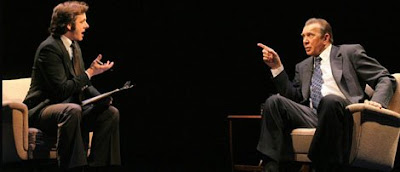
A few years back, I would have told you Ron Howard was the biggest hack in Hollywood. The Da Vinci Code? A Beautiful Mind? Splash? Yawn. Across the board, this guy was making sappy garbage and being touted as one of the most prominent directors in the industry. But since he signed on to Arrested Development, I simply haven't been able to look at lil' Opie Taylor the same way. Frost/Nixon is Howard's best film since Apollo 13, and is decidedly un-Ron Howard. He takes a subject that even I -- a student of political science -- had little interest in (a series of post-Watergate interviews with former President Nixon conducted by British TV personality David Frost) and makes a fairly compelling story of it. It's certainly overdramatized at times, but the film's casting director deserves an AIG-style bonus for giving Frank Langella the role of Nixon. In a year when everyone (including myself) was commending Sean Penn for talking with a lisp and kissing James Franco, Langella fills the shoes of one of America's most recognizable and notorious faces with ease. Rourke was better, yeah, but hell if I saw a more gripping scene all year than a drunken Nixon yelling into a phone in the dead of night.
4. Marley & Me (director: David Frankel; starring: Owen Wilson, Jennifer Aniston, Alan Arkin)

If you saw a billboard for Marley & Me, it probably looked like this. Result: most people, myself included, assumed it was some shitty kids movie about a cute dog. To my surprise, this stars Owen Wilson and Jennifer Aniston (note to studios: put mega-celebrities on billboards, not dogs) in a story that relies on "Marley the dog" as a framing device more so than the central plot focus. The real story, based on this book, is about a just-married couple and the hardships that accompany the standard American life. We watch Wilson & Aniston as they transition (deteriorate?) from youthful, sex- and career-driven optimists to mature, family-juggling suburbanites. I was amazed at how much I connected with and cared for the characters as I watched them grow in and out of love. There's also a solid supporting cast, which includes Alan Arkin, Eric Dane, and that older guy from The Wire. The movie ends predictably -- the studio's horrendous marketing campaign even used this to target sympathetic viewers -- but if you've lost a dog in your lifetime, it's worth seeing the film simply to remember the unmatched joy our pets bring us. Miss you, Bob.
5. Waltz With Bashir (director: Ari Folman; starring: Ari Folman, Dror Harazi, Ronny Dayag)

A foreign, animated documentary is like the film equivalent of a blind, one-legged midget. All things considered, Waltz With Bashir got a substantial amount of press last year for its grim portrayal of the 1982 Israeli invasion of Lebanon. The protagonist is director Ari Folman, and the plot is essentially his effort to remember the events of the war, which he has perhaps not-so-curiously forgotten. The narrative is thus told first-hand by a series of real life interviews with soldiers, journalists, and friends of Folman's that were involved in the conflict. The stories told by these interviewees are depicted by a unique form of animation that is absolutely stunning, to say the least. The technique used, which resembles "rotoscoping," the meticulous process of drawing over live film frames (as famously used in Waking Life), was developed specifically for Waltz. The process began with a 90-minute live film shot in studio, which was then laid out on a storyboard. Next, the storyboard was used to draw 2,300 free standing illustrations. Then (this is the cool part): "Each drawing was sliced into hundreds of pieces which were moved in relation to one another [in a computer program], thus creating the illusion of movement." But the film's strengths reach far beyond its mere look. In particular, it's difficult to forget the utter silence of the theater in Waltz's closing two-minutes, which personally ran chills down my neck. Finally, I mustn't neglect to mention Max Richter's brilliant original score, which actively and effortlessly supports this unique and commendable film.


